How Agentic AI Is Changing Vehicle Development
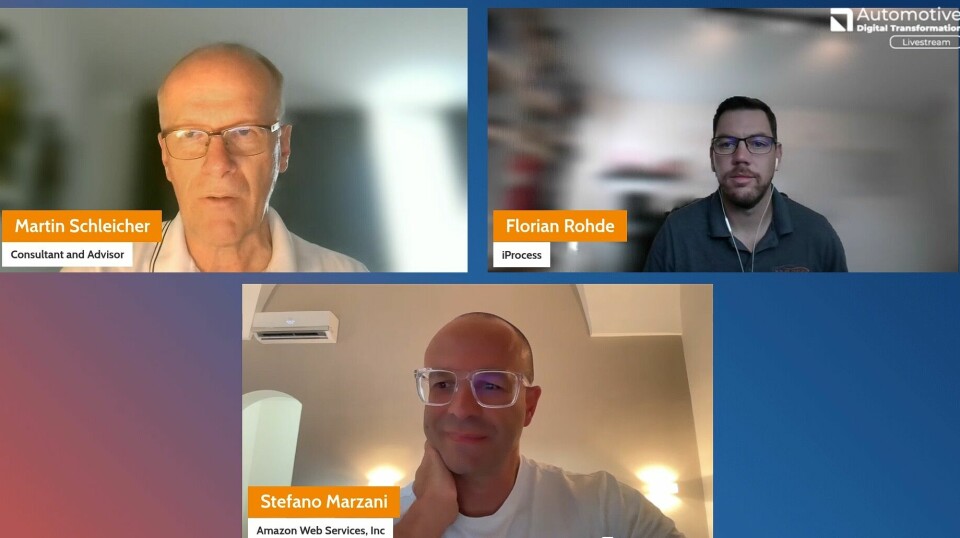
Martin Schleicher, Florian Rohde and Stefano Marzani discussed how agentic AI could reshape automotive software development, validation and the software-defined vehicle ecosystem.
Ultima Media
Agentic AI could speed up requirements, testing, validation and SDV workflows. But automotive experts warn that without APIs, virtual ECUs, clean data and human expertise, the hype will not scale.
Agentic AI is moving from buzzword to engineering tool. In the ADT expert talk ahead of Automotive Software Strategies US 2026, which takes place on November 3 and 4 in San Jose, three members of the conference advisory board discussed how autonomous, goal-driven AI systems could reshape automotive software development, validation and the software-defined vehicle ecosystem.
The panel brought together Florian Rohde, Managing Partner at iProcess, Stefano Marzani, Emerging Tech Strategy Leader for Automotive and Manufacturing at AWS, and moderator Martin Schleicher, independent consultant and Conference Chairman. Their conversation focused on a central question: What can agentic AI already do in automotive software – and where does the industry still need to be careful?
Schleicher opened by pointing to the rapid rise of AI-assisted software development. Yet the panel quickly moved beyond the idea that AI simply writes code. Rohde challenged a common misconception: “A lot of people think a software engineer is writing code the whole day, eight hours, and that isn’t true and has never been true before.” Engineering, he stressed, also means architecture, analysis, validation, timing and system understanding.
Marzani agreed and described agentic AI as one of the most significant shifts he has seen in automotive software development. For traditional OEMs and suppliers, he sees a major chance to modernize development processes and reduce long-standing inefficiencies.
What agentic AI can already do today
According to the panel, the first strong use cases are not futuristic vehicle functions, but everyday engineering work. Agentic AI can support requirements generation, consistency checks, documentation, code generation, test case creation and verification workflows.
Rohde described this as a way to move tedious process work away from engineers. The goal is not to remove human expertise, but to let engineers focus more on innovation. “As an engineer, what really drives us, what really excites us? Innovation,” he pointed out.
Marzani took a broader view. He said AI can already help across requirements, models, code and verification. He sees particularly strong potential in V&V: “V&V is insane what GenAI can do.” In the verification and validation work that defines much of automotive software development, agentic AI could help generate test vectors, check consistency between requirements and code, support fault injection and prepare ASPICE-related evidence. Used in the right engineering environment, this could increase both speed and coverage.
Still, the experts warned that agents are not a magic layer. Schleicher pointed to the old principle of garbage in, garbage out. Good prompts and clear intent matter. But so do structured data, understandable requirements and a mature engineering process.
Why virtual ECUs are essential for agentic workflows
For Marzani, agentic AI needs the right technical foundation. Agents cannot scale efficiently if they depend on physical hardware located somewhere on an engineer’s desk. “Agents can’t scale really very well if they have to deal with a piece of hardware that is on a desk somewhere in the world,” he said.
That makes virtual ECUs, software-in-the-loop environments and cloud-native engineering workbenches central to the discussion. The more development and testing can be virtualized, automated and reproduced, the more effectively agents can interact with the engineering environment.
This has direct consequences for the toolchain. Classical graphical user interfaces may remain useful for people, but agents need APIs, command-line interfaces and model context protocol servers. Rohde recalled a discussion from his time at Tesla, when he told a tool vendor: “Everything I can do with a mouse click, I need to be able to do through a command line.”
His conclusion: “UI or GUI only tools will have a very hard time from here on forward.” If a tool cannot be accessed by agents, it risks being left out of future development workflows.
How far the automotive industry has already moved
Schleicher said companies with automated build environments, Git-based workflows and scalable CI/CD structures are already in a strong position. He had expected many organizations to still be in proof-of-concept mode. Instead, he found that some companies can integrate agents quickly because their software processes are already highly automated.
Marzani confirmed the speed of change: “I never saw an activation like this one in the automotive industry. So quick, so deep.” However, he also warned that fragmented vehicle architectures remain a limitation. Putting agents on top of a highly distributed system with many individual ECUs will not create efficiency by itself. Platform engineering, consolidation and virtualization are needed first.
Rohde added an important distinction: Most current use cases, he said, are focused on R&D workflows rather than safety-relevant AI functions running inside the vehicle. Requirements, traceability, compliance checks and test generation are one side. AI in vehicle functions is a different and much more regulated topic.
What agentic AI means for safety and compliance
The panel treated functional safety with caution. Asked whether agent-generated software could one day enter the vehicle without further human checking, Rohde answered: “Eventually. At one point.”
Marzani explained that agentic AI is increasingly moving toward loop-based systems. Instead of one prompt producing one output, agents work toward defined objectives, verify results and feed findings back into the process. If a requirement can be verified within such a loop, he argued, the evidence generated by that verification becomes central to the engineering process.
At the same time, he acknowledged a gray area: an agent itself is not a deterministic, certified tool. Rohde added that standards such as ASPICE were originally designed for human assessors doing spot checks. Agentic AI can potentially check far more artifacts and traceability paths, maybe even full coverage. That creates a major opportunity and a challenge for standards and assessment methods.
The message was therefore clear: AI does not replace safety engineering. It may strengthen consistency, coverage and traceability, provided it is embedded in rigorous processes and reviewed by people who understand the system.
How agents could improve diagnostics and fleet learning
Beyond development, the experts also discussed vehicle operation. Rohde described how difficult it used to be to identify rare field issues from large vehicle data sets. With agentic AI, engineers can analyze much larger amounts of data and search for anomalies they might not know in advance. His example instruction to an agent: “Please find something that looks fishy.”
This could become valuable for diagnostics, prognostics and security analysis. Marzani connected the idea to a cloud-to-edge loop: vehicle data is collected, triaged by agents, assigned to the right engineering team and linked to possible reproduction environments. In the future, an agent could help identify a rare failure, suggest a likely cause and prepare the configuration needed to reproduce the bug. That keeps the engineer in the loop. But it could shorten the path from field symptom to corrective action.
Why SDVs need a software-defined supply chain
The long lifetime of vehicles adds another layer of complexity. Rohde argued that the industry must move away from the idea of writing software once and maintaining it unchanged for years. Vehicle software needs to be continuously maintained.
Marzani expanded the point to suppliers and OEMs: “There’s no software-defined vehicle without the software-defined supply chain.” OEMs, he said, must guide suppliers toward modern engineering practices, virtual ECUs, platform engineering and cloud-native development.
The panel also touched on source code and business models. Rohde argued that source code itself may become less decisive as intellectual property if AI can generate it. The real value may lie more in design, domain expertise and the way this expertise is embedded in the product.
Marzani described this as the kind of “agentic harness” companies create around their expertise. For end customers, however, the decisive result remains simple: better user experience at an affordable price.
Why expertise still matters in the AI era
The panel ended with a realistic view. Agentic AI can accelerate development, improve validation and support new software-defined vehicle workflows. But it increases the need for experienced engineers who can judge whether an AI result is useful, safe and technically sound.
Rohde gave the clearest warning: “If you don’t know what you’re talking about, you make yourself look like a fool when you just use AI outputs without understanding them.” Schleicher summed it up with a familiar phrase that still fits the AI age: “A fool with a tool is still a fool.”
That is why the full discussion is worth watching. It shows where agentic AI is already useful, what has to change in architectures and toolchains, and why automotive software will be shaped not only by AI models, but by the people and processes around them.