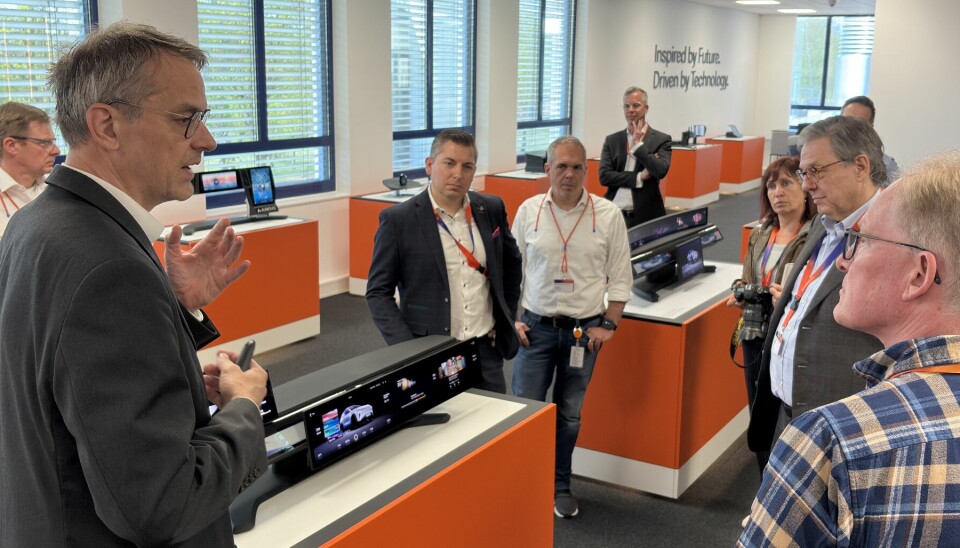
“We want to bring more emotion to the vehicle interior”
When Automotive UX Becomes SDV Architecture
Benjamin MüllerBenjaminMüllerInternational Editor for ADT, aIT, AP & All-Electr.
3 min
A high-quality networking event near Frankfurt: Aumovio’s User Experience Technology Expo 2026.Benjamin Müller
In-display sensing, projected surfaces and AR technologies show how automotive UX is moving beyond the interface. What matters now is integration, validation and calibration across the SDV stack – a shift clearly visible in Aumovio’s current concepts.
Automotive UX is still too often discussed as a question of
interface design. In SDV programmes, however, its success is increasingly
decided much deeper in the stack: by data paths and orchestration, safety cases
and lifecycle validation, and calibration stability.
A central figure at the Expo: Pavel Prouza. Since 2024, the Czech national has been in charge of user experience at Aumovio. Before that, he held roles at Continental including Head of Motion Technologies and Services and Head of Controlling Hydraulic Brake Systems.Benjamin Müller
A look at Aumovio’s current concepts shows how strongly
these demands are shaping vehicle development in 2026.
They sketch an emerging stack in which optics and projection turn non-display
surfaces into information layers, while sensing becomes an invisible input
channel.
Invisible in-display sensing: validation first
Advertisement
Instead of adding another output surface, Aumovio’s Invisible
Biometrics Sensing Display hides sensing behind one. A 1.5 MP near-infrared
camera and an eye-safe laser dot projector sit behind an OLED display, enabling “see-through” driver and
occupant monitoring without visible hardware. The concept was developed with Trinamix
and previously recognised as a CES Innovation Award Honoree.
Realistic simulation: At the Expo, Aumovio’s Head of Optical Engineering HUD, Hans-Peter Kreipe, offered visitors quite literally some revealing insights.Benjamin Müller
Functionally, it targets safety and wellbeing: a 3D depth
map can support airbag deployment decisions, seatbelt detection, including
textile classification, and contactless biometrics such as heart rate to flag
stress or medical events. The design benefit is equally relevant: hiding the
hardware can improve acceptance while giving interior designers more freedom.
Architecturally, the moment biometrics and depth data enter
the system, the discussion shifts from “nice UX” to platform-level obligations:
safety boundaries, cybersecurity, privacy-by-design and evidence.
Window Projection: a new touchpoint
Window Projection adds an exterior-facing UX channel:
content is projected onto rear side windows when parked, allowing the vehicle
to communicate with its surroundings. Example use cases range from EV charging status to personalised welcome messages or
motifs.
Surface Projection: ambient effects and functional cues
Surface Projection turns the cockpit trim into a
pillar-to-pillar canvas for ambient effects and selective functional cues such
as navigation hints and warnings. The system uses compact projectors integrated
in the headliner or overhead unit; up to three miniature projectors can be
combined, with software stitching their outputs into one continuous image
across the cockpit surface. As Alexander Weber, Head of Development at
Continental – from whose former Automotive business Aumovio emerged – put it at
the UX Expo: “We want to bring more emotion to the vehicle interior”.
Advertisement
That ambition is easy to understand. Yet what makes the
concept relevant for series development is something more technical. The
projection surface is not a controlled display panel, but a manufactured trim
part with tolerances, textures and ageing behaviour. Aumovio notes that the
concept does not impose special material requirements, although darker
surfaces, including microfibre velour, deliver the best visual results. In
practice, perceived quality will hinge on tolerance stack-ups, reflectivity changes
and calibration robustness across variants and lifetime.
The system also highlights how UX features become
context-aware and energy-aware. Aumovio mentions dusk activation and low power via LED projection – decisions that may sound minor,
but ultimately determine where the feature sits in the vehicle’s UX policy
layer and how consistently it behaves in day-to-day use.
Mirrorless 3D AR HUD: calibration first
Aumovio’s mirrorless AR HUD is a useful example of how UX
features increasingly hinge on platform-level engineering. The SDV-relevant
claim is scalability: instead of tailoring optical elements per vehicle,
software compensates for windscreen specifics such as curvature and angle.
Aumovio’s AR-Creator software is positioned as a core component: it evaluates
sensor data, compensates motion between vehicle and virtual objects, and keeps
AR content anchored in the driver’s view.
Jan Mackenroth, Head of Innovation & Partnership Management (BA UX) at Aumovio, describes the 360°UX Mobility Conference as “a very interesting new format for networking across the industry”. As one of the event’s speakers, he brings more than ten years of industry experience to the stage, particularly from Asia.Benjamin Müller
The 3D effect adds another integration layer. Using eye
tracking, the system outputs a slightly different image to each eye. Aumovio
references a depth range of 0.6–80 m and a display area of more than 15° × 8°.
Those figures translate into platform questions: what sensing inputs are
available, how time synchronisation is handled, and how calibration stays
stable across lighting conditions, seating positions and vehicle lifetime.
Only once that software-calibration story is in place does
the “mirrorless” hardware benefit become fully meaningful: replacing the
classic mirror-based optical path with a 3D display reduces the HUD package –
Aumovio cites up to 50% less packaging volume versus conventional HUDs. In a
crowded cockpit, that packaging bonus can be the difference between a scalable
feature and a one-off integration exercise.